We use cookies to improve our services. By continuing to navigate the site, you agree to the terms of use of cookies.
Filters
Map search
06 Jan 2026
Peering, Transport and IP Transit in Modern Networks: How European Operators Build Connectivity - and How GNM Enhances It
1. Peering - the foundation of low-latency interconnection
Peering enables two networks to exchange traffic directly, without intermediate transit carriers. The engineering benefits are straightforward:
- Fewer AS hops;
- Lower latency;
- More predictable paths;
- Less exposure to transit congestion;
- Lower cost for high-volume traffic.
Europe’s interconnection model relies heavily on peering. Major hubs such as Frankfurt, Amsterdam, Warsaw, Stockholm and Prague host a high concentration of networks and provide extensive peering opportunities.
How GNM implements peering
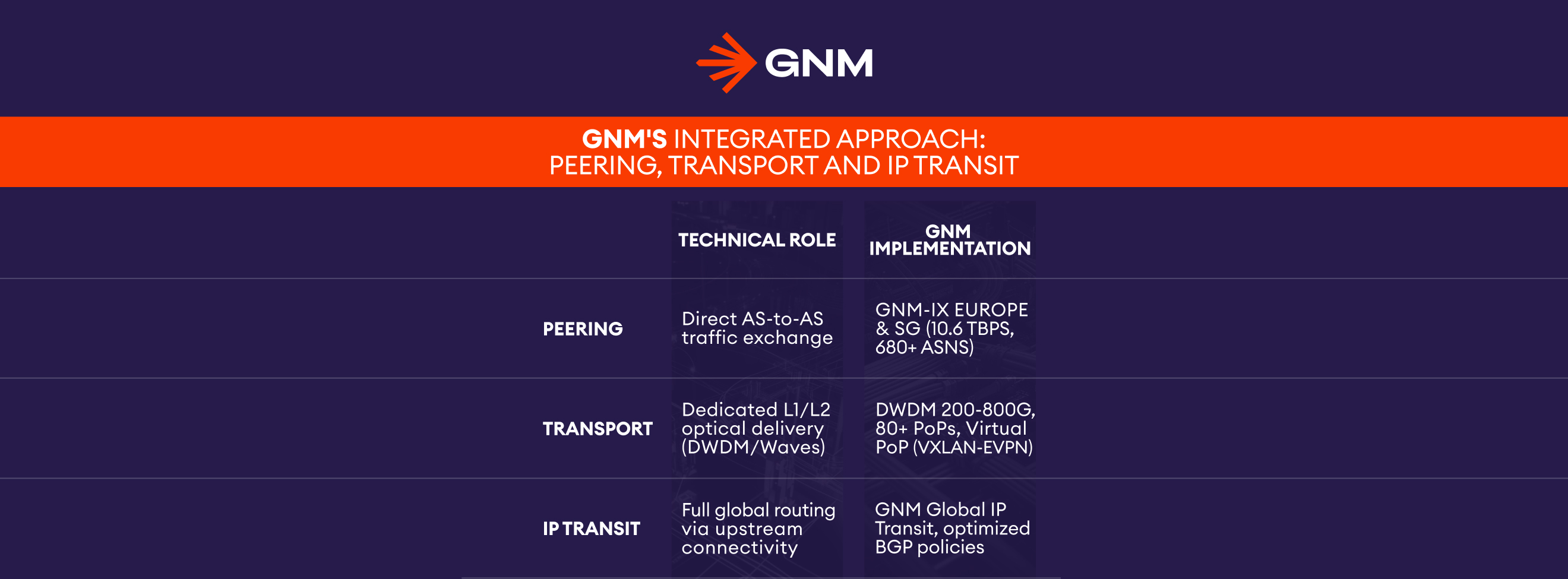
GNM operates GNM-IX, currently at 10.6 Tbps peak load with 690+ connected ASNs.
The platform is designed around engineering priorities:
- Consistently low per-port latency;
- Predictable routing policies;
- Equal access for all members;
- Scalable capacity options: 10G, 100G and 400G.
With a single port, participants can establish direct BGP sessions with major European networks, CDNs, cloud providers and carriers. GNM-IX helps networks reduce transit costs, improve latency, and decrease dependency on Tier-1 providers - without requiring major architectural change.
2. IP Transit - global reach and full routing visibility
IP transit provides access to the entire global internet. Even operators with extensive peering still need transit to reach the “long tail” destinations without direct interconnection.
The European transit market is highly competitive. Prices for 100G ports have dropped significantly, so what really differentiates providers now is routing quality, resilience and SLA.
How GNM provides IP Transit
GNM offers global transit delivered across its own 20,000+ km DWDM backbone, connecting 80+ PoPs across 21 countries, including major hubs: Amsterdam, Frankfurt, Warsaw, Katowice, Stockholm, Vienna, Prague, Bucharest, Belgrade, Singapore and more.
Technical characteristics:
- 200 - 800 Gbps optical wavelengths on GNM’s DWDM system;
- Wide upstream and content-side connectivity;
- 99.98% SLA;
- BGP optimization (multi-homing, well-structured communities, filtering and policy control).
Because of GNM’s extensive Internet Exchange Network, many of our transit paths are shorter than classic Tier-1 routes. Operators gain predictable latency, stable routing, global coverage and flexible capacity options ranging from 1G to 400G.
3. Transport - geographic expansion without CAPEX or on-site deployment
Transport is dedicated L1/L2 connectivity between two network locations.
Typical use cases include:
- Remote peering into IXPs;
- Connecting an operator’s own PoPs across different cities;
- Traffic delivery for CDN/OTT platforms;
- Private corporate network backbones.
How GNM implements transport
GNM operates a private DWDM network across Europe and Asia using leading optical vendors. The design enables:
- Low-latency optical paths;
- Guaranteed bandwidth (100G/400G waves);
- Avoid congested public routes;
- IXP access without physical colocation.
GNM also offers Virtual PoP built on our VXLAN-EVPN fabric, enabling operators to deploy a full routing/switching presence in any GNM PoP with zero hardware and zero CAPEX. Operators can extend their footprint into Amsterdam, Frankfurt, Warsaw, Stockholm or almost any major city within 24 hours - without logistics, equipment shipping or rack work.
Why the hybrid approach is the most efficient
Operators that combine all three mechanisms usually achieve the most efficient architecture:
- Peering → lowest latency and lowest cost for large traffic volumes.
- IP Transit → complete global routing visibility and redundancy.
- Transport → fast geographic expansion without capital expenditure.
GNM provides all three services over a single backbone. This allows networks to be designed around actual traffic requirements - from high-load OTT platforms to regional ISPs expanding toward European hubs.
5. Why operators choose GNM
- Cost efficiency: a peering + transit mix reduces cost per Mbps and relieves pressure on upstream transit links;
- Better end-user performance: shorter paths to European hubs, closer peering edges and optimized CDN connectivity directly improve latency and user experience;
- Scalability without infrastructure investment: virtual PoP, remote peering and backbone transport enable expansion without deploying hardware.
- Engineering-driven operations: fast provisioning, transparent configs, no vendor lock-in and responsive 24/7 engineering support.
- A rapidly growing interconnection platform: GNM-IX ranks among the top five IXPs by ASN count and is recognised by Google with Gold Peering Provider Status.
- GNM’s backbone architecture provides shorter paths to major content networks than typical Tier-1 routing.
GNM can design a tailored network architecture - from a single port to multi-site deployments. We deliver all three connectivity services - Peering, IP Transit and Transport - giving operators the ability to build stable, scalable and low-latency networks that deliver consistent performance to their end-users.
For peering, transit or transport inquiries, please, contact sales@gnm.net.